

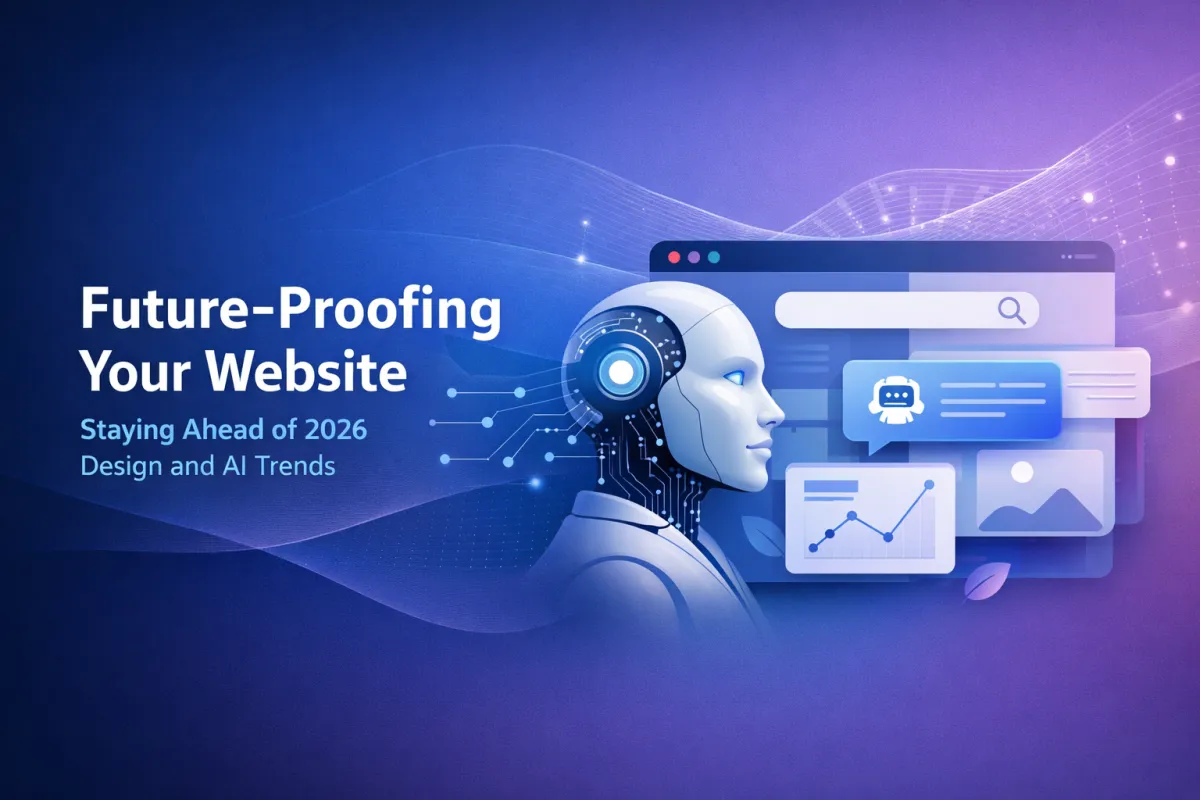
Future‑proofing your website: staying ahead of design and AI trends
Introduction
In 2026, your website isn’t just a digital business card—it’s an immersive platform powered by intelligent design and forward-thinking technology. With over 90% of online experiences starting with a website visit and AI expected to influence more than 60% of web user journeys by 2026, future-proofing your site has never been more essential.
Whether you’re an entrepreneur scaling a startup, a marketer optimizing brand engagement, or a business leader driving growth, the rapidly evolving landscape of web design and artificial intelligence demands attention. Businesses that fail to adapt risk losing visibility, engagement, and revenue to competitors who move faster.
In this comprehensive guide, we’ll explore upcoming web and AI trends, why they matter for long-term performance, how to implement them strategically, common mistakes to avoid, and a practical roadmap to get started. By the end, you’ll know exactly how to future-proof your website for 2026 and beyond.
Understanding the Concept: What It Means to Future-Proof Your Website
Future-proofing your website means designing and developing it in a way that remains relevant, adaptable, and high-performing as technology, user behavior, and market expectations evolve. Instead of reacting to trends, a future-proof website anticipates change—whether from search engine algorithm updates, new devices, sustainability demands, or AI-driven user expectations.
Core Concepts
Intelligent Personalization
Leveraging AI to create unique, behavior-based user journeys rather than one-size-fits-all experiences.
Design Fluidity
Moving beyond rigid grid layouts toward organic, human-centered aesthetics that feel natural and intuitive.
Sustainability
Reducing environmental impact through optimized performance, efficient code, and green hosting strategies.
Mobile-First Thinking
Prioritizing speed, usability, and interaction on mobile devices, where most traffic now originates.
AI-Assisted Design Tools
Using machine learning for smarter design decisions, performance optimization, analytics, and testing.
Historically, websites evolved from static pages in the 1990s to responsive layouts in the 2000s, then mobile-first frameworks, and now AI-driven interfaces. What makes 2026 different is the convergence of AI, visual innovation, performance optimization, and personalization at scale.
Real-World Example
Shopify has successfully integrated AI-powered product recommendations, personalized checkout experiences, and a mobile-native design philosophy. These elements work together to increase engagement, improve conversion rates, and drive repeat purchases.
Why Future-Proofing Matters for Today’s Businesses
Staying ahead of web and AI design trends isn’t a branding luxury—it’s a strategic necessity.
Search engines already prioritize speed, usability, accessibility, and mobile performance. Meanwhile, users expect personalized experiences that respond instantly to their needs. As AI increasingly shapes how people browse, search, and interact online, outdated websites struggle to compete.
Key Benefits
Increased Conversions
Personalized, AI-driven experiences can improve conversion rates by more than 30%.
Brand Differentiation
Modern aesthetics, micro-interactions, and thoughtful UX create stronger first impressions.
Operational Efficiency
AI automates tasks like testing, personalization, analytics, lead qualification, and content delivery.
Environmental Responsibility
Sustainable web design aligns with consumer values while improving performance and speed.
Case Study
Patagonia’s website demonstrates future-proof principles through eco-friendly design choices such as compressed assets, system fonts, clean UX, and minimal code. The result is a fast, visually compelling site that aligns with the brand’s environmental mission while driving strong engagement.
Effective Strategies to Master Future-Proof Website Design
1. Conduct a Website Health Audit
Start by evaluating your current foundation:
Review Core Web Vitals and mobile usability in Google Search Console
Analyze bounce rates, session duration, and conversion paths in Google Analytics
Identify gaps in personalization and automation
Review CMS flexibility and scalability
A clear audit reveals whether you need incremental improvements or a structural rebuild.
2. Integrate AI-Powered Personalization
AI allows your website to adapt to each visitor in real time:
Behavioral segmentation based on browsing patterns
Smart chatbots that adjust language and content based on intent
Dynamic content and product recommendations
Automation platforms like Go HighLevel make it possible to combine CRM data, email flows, SMS, and intelligent content delivery into a single ecosystem—without complex custom development.
3. Adopt Human-Centered Design with Emerging Aesthetics
Design trends in 2026 emphasize clarity, motion, and emotional connection:
Organic shapes and asymmetrical layouts
Kinetic typography and variable fonts for accessibility and storytelling
Scroll-triggered animations, parallax effects, and subtle micro-interactions
The goal is not visual overload, but intentional movement that guides attention and enhances usability.
4. Prioritize Sustainability and Speed
Performance is no longer optional—it directly impacts rankings, conversions, and user trust.
Key sustainability practices include:
Hosting on eco-friendly servers
Using compressed images (WebP), lazy loading, and minimal JavaScript
Leveraging system fonts and clean CSS
Optimizing mobile delivery and caching
Fast websites are more discoverable, more engaging, and more environmentally responsible.
5. Optimize for Accessibility and Inclusivity
A future-ready website must work for everyone:
ADA-compliant contrast ratios and readable typography
Keyboard navigation and screen-reader compatibility
Dark mode options that reduce eye strain
Clear information hierarchy and intuitive navigation
Inclusive design improves usability for all users—not just those with disabilities.
Common Mistakes Businesses Should Avoid
Ignoring Mobile Speed Optimization
Even a one-second delay can significantly reduce conversions. Mobile speed is now a ranking and revenue factor.
Overusing Animation or 3D Effects
Immersive design can enhance engagement, but excessive motion slows performance and distracts users from key actions.
Delaying AI Adoption
Many businesses assume AI is too complex or expensive. In reality, small, targeted AI integrations often deliver the highest ROI.
Getting Started: Practical Steps for Future-Proofing Your Website
Follow this action plan:
Assess current performance (speed, UX, SEO, mobile usability)
Assemble scalable tools (CMS, automation, analytics)
Implement strategic design updates
Integrate AI-driven personalization
Audit sustainability and performance
Launch, measure, and continuously optimize
Future-proofing is not a one-time project—it’s an ongoing system.
The 2026-Ready Website Checklist
Mobile-first performance under 3 seconds
AI-driven personalization or automation
Flexible, human-centered design
SEO-optimized structure and content
Accessible and inclusive UX
Lightweight, sustainable performance practices
Scalable CMS and marketing systems
If your site is missing more than two of these, it’s already falling behind.
Final Thoughts: Future-Proofing Is a Competitive Advantage
Websites that win in 2026 won’t just look better—they’ll think smarter, adapt faster, and convert more consistently.
Future-proofing means designing for people, using AI to enhance decision-making, building scalable systems, and treating your website as a growth engine—not a brochure.
Businesses that invest now won’t be forced to catch up later. They’ll already be ahead.
Ready to Future-Proof Your Website?
If you want a website built to perform for years—not months—focus on intelligent design, automation, and adaptability from day one.
Your website should work as hard as you do.
Now is the time to make sure it’s ready for what’s next.
